
Content intended for healthcare professionals. By continuing, you confirm you are a HCP.
Trabecular Bone Score
Trabecular Bone Score® (TBS®) enriches fracture-risk assessment by capturing the structural information BMD leaves out — the bone microarchitecture that helps determine whether bone breaks.
What is TBS?
Trabecular Bone Score® is an innovative analytic method that enriches fracture-risk assessment. Using a patented, modified experimental-variogram approach, the TBS® algorithm interprets subtle grey-level, pixel-by-pixel variations in a bone's projected DXA image and translates them into an estimate of three-dimensional bone microarchitecture.
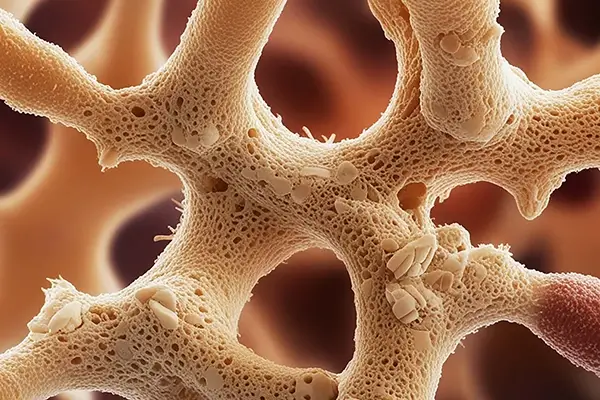
TBS® correlates strongly with the intrinsic microarchitecture and mechanical competence of bone — complementing the BMD T-score, which primarily reflects bone quantity.
BMD and TBS
BMD measures how much bone is present. TBS® measures how well it's built. Two patients with an identical BMD can have very different microarchitecture — and very different fracture risk.
Why TBS?

Strong microarchitecture: High or average TBS®
Normal fracture risk

Fragile microarchitecture: Low TBS®
elevated fracture risk
TBS® adds the structural dimension that density alone can't see, so patients at risk of a fragility fracture hiding with a "normal" BMD are no longer missed.
The clinical need
of osteopenic patients are reclassified when TBS® is added to BMD — improving the accuracy of fracture-risk assessment, particularly in osteopenia and secondary osteoporosis.1
Explaining TBS to patients
A useful analogy for the clinic: Think of bone as a brick wall.
BMD describes the bricks: How much material is present. TBS® describes the quality: The condition of the bricks, how those bricks are placed, and the mortar between them.

Osteopenic bone density
TBS® reveals the fracture risk BMD alone can miss
TBS · Trabecular Bone Score
TBS® is a patented, validated analytical index derived from routine DXA scans, revealing the internal structural quality of bone that BMD cannot measure. More than a decade of peer-reviewed research underpins its clinical use worldwide.
4.5M+
TBS® evaluations performed annually2
1,600+
peer-reviewed publications2
35+
clinical guidelines citing TBS®2
90+
countries with clinical deployments2
Clinically proven
2026 · Diagnostics
Beyond DXA: Trabecular Bone Score, Quantitative Ultrasound and Bone Turnover Markers for Morphometric Vertebral Fracture Assessment in People Living with HIV
Razvan, D.V., Rosca, O., et al.
2024 · The Journal of Clinical Endocrinology and Metabolism
Trabecular Bone Score as a Marker of Skeletal Fragility Across the Spectrum of Chronic Kidney Disease: A Systematic Review and Meta-analysis
Bioletto, F., Barale, M., et al.
2023 · Osteoporosis International
Long-term Effect of Denosumab on Bone Microarchitecture as Assessed by Tissue Thickness-adjusted Trabecular Bone Score in Postmenopausal Women with Osteoporosis: Results from FREEDOM and its Open-label Extension
Hans, D., McDermott, M., et al.
Go deeper
Everything behind TBS®: The analytic method, the biology, the clinical applications, and the published record.
Bone microarchitecture
TBS® as a primary, secondary or safety endpoint, capturing microarchitectural change BMD can miss
TBS in secondary osteoporosis
Protocol and statistical input on where and how bone-quality measures strengthen your evidence
Publications
Documentation and QC aligned to an ISO 13485 quality system, ready for submission scrutiny
We help clinicians reveal more from routine imaging — every patient, every scan — for better care.